
Dinosaurs
Tyrannosaurus rex: the people and fossils that made history
23 October 20264 min read
Before it became a star, it was a puzzle
It is hard to imagine Tyrannosaurus rex without its enormous head and imposing teeth. Yet palaeontologists did not find it whole, waiting underground like a figure inside a box. Its scientific history was pieced together through incomplete skeletons, expeditions and comparisons between bones, millions of years after the animal took its final steps.
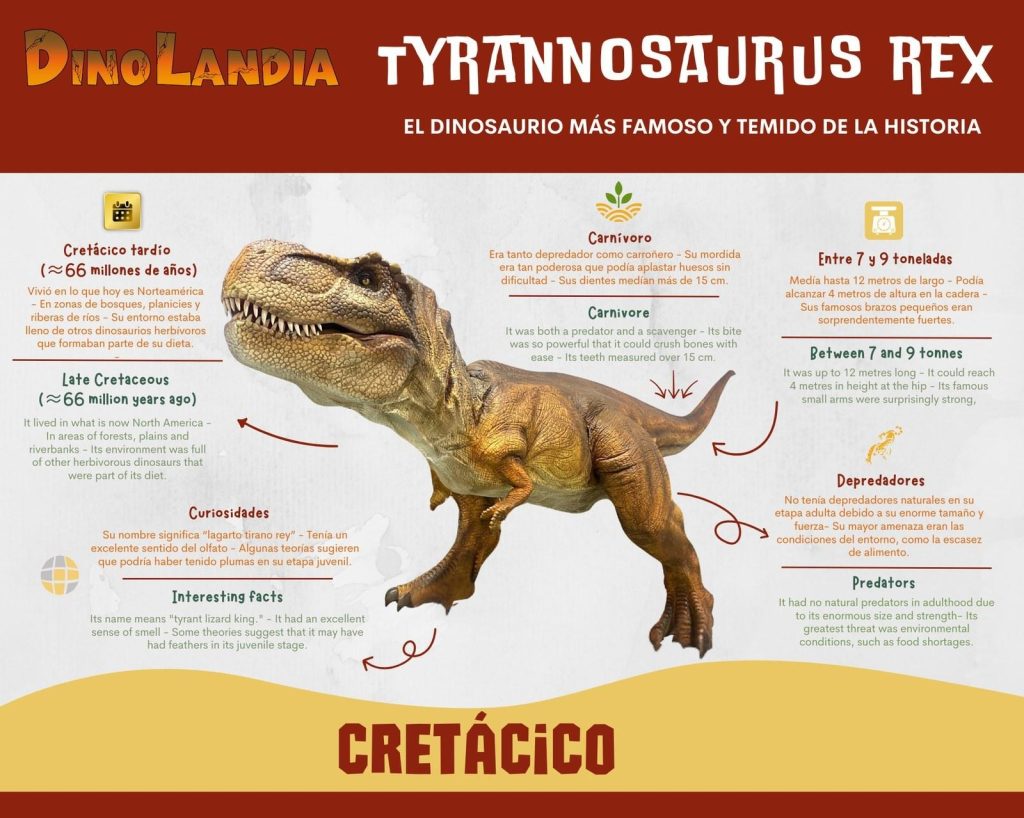
This dinosaur lived at the end of the Cretaceous, in what is now western North America. But naming it and reconstructing its appearance required something very human: finding clues, recognising their importance and accepting that some early interpretations might be wrong.
Behind that adventure are a fossil hunter called Barnum Brown, a palaeontologist called Henry Fairfield Osborn and a discoverer whose name would eventually be given to one of the most famous specimens.
Barnum Brown and the bones of Montana
In 1902, Barnum Brown found remains in Montana of the skeleton that would be used to formally describe Tyrannosaurus rex. He worked for the American Museum of Natural History in New York and would become one of the great names in dinosaur hunting.
The discovery came from the Hell Creek Formation, a sequence of rocks renowned for preserving fossils from the end of the Cretaceous. No complete animal emerged: what remained had to be interpreted and compared with other known dinosaurs.
Here it is worth pausing to consider a less cinematic part of palaeontology. Finding a bone is only the beginning. Next comes:
- Carefully removing the surrounding rock.
- Protecting the remains so they can be transported.
- Preparing, describing and comparing them in the laboratory.
Blocks of rock containing fossils can be enormous and very heavy. That is why an expedition needs as much organisation as a keen eye. Brown did not just look for bones: he took part in the lengthy work needed to move them from the excavation site to a scientific collection.
Osborn gave it a name… and there was a mix-up
In 1905, Henry Fairfield Osborn described and named Tyrannosaurus rex. The name combines Greek and Latin roots and is usually translated as ‘king of the tyrant lizards’. It was certainly not an understated introduction.
But there was something curious about that debut: in the same paper, Osborn gave another name, Dynamosaurus imperiosus, to remains that Brown had discovered in Wyoming in 1900. He initially considered them to belong to a different dinosaur.
After comparing them more closely, Osborn concluded that both belonged to the same type of animal. The name that was retained was Tyrannosaurus rex.
This story shows that naming a species is not simply a matter of choosing impressive words. You have to establish whether its features really are different from those of animals already described. When fossils are incomplete, that task can become very complicated.
It also offers a useful lesson for young researchers: correcting an identification does not spoil science. It is precisely one of the ways science moves forward.
Another discovery and a change in posture
Brown found another important T. rex skeleton in Montana in 1908. This specimen, which included an exceptionally complete skull, helped expand knowledge of its anatomy and became a key part of the American Museum of Natural History’s collection.
Having more bones makes it possible to check proportions and identify more clearly which parts are missing from other specimens. Even so, a skeleton does not come with assembly instructions, and reconstructing an extinct animal’s posture requires interpreting how its joints fitted together and worked.
For much of the 20th century, T. rex was depicted standing very upright, with its tail resting on the ground. Today we know that it held its torso much more horizontally and its tail raised, acting as a counterbalance.
The next time you see an old illustration, you can make a game of spotting that difference. You will not be looking at a different dinosaur, but at a different stage in its scientific history.
Sue: a name, not a clue to its sex
In 1990, Sue Hendrickson discovered Tyrannosaurus rex remains in South Dakota. The specimen was named Sue in her honour and became one of the most complete known skeletons of this species.
It is now housed at the Field Museum in Chicago. Its importance goes beyond its spectacular appearance: such a complete skeleton makes it possible to study many parts of the same individual, rather than gathering information from different animals.
And here we come to a common misunderstanding: the fact that the fossil is called Sue does not mean we know it was female. The nickname commemorates its discoverer; it is not an identification of its sex.
This distinction is a useful starting point for family conversations about science. The name we give a discovery is one thing; what its bones allow us to prove is another. Even the most famous fossils still hold unanswered questions.
Come and meet Tyrannosaurus rex at Dinolandia
After following its trail through museums and fossil sites, you can meet the Tyrannosaurus rex at Dinolandia, the animatronic dinosaur park at El Bosque Encantado, in San Martín de Valdeiglesias.
It is in the Sierra Oeste, 50 minutes from Madrid, with life-size animatronic dinosaurs among pine and holm oak trees. As you look at it, bring a researcher’s question with you: what could Brown and Osborn deduce from a few incomplete bones?
Fancy seeing them in person?
Dinolandia, El Bosque Encantado and Mineralandia: three parks in one, 50 minutes from Madrid.
Buy tickets